
CFS Calibration Suite®
Engineered for DICOM Precision
CFS Calibration Suite® delivers automated DICOM GSDF calibration and quality assurance for enterprise medical display networks. Designed exclusively for diagnostic imaging environments, it keeps every display in your facility compliant and audit-ready — without manual intervention at the monitor. Developed in the USA by Double Black Imaging.
- Automated DICOM Part 14 / GSDF Calibration
- Automated sRGB Calibration for Digital Pathology
- Remote Enterprise-Wide QA Management
- AAPM TG18 / TG270 Compliance Support
- MQSA Mammography Workflow Support
- Developed in the USA
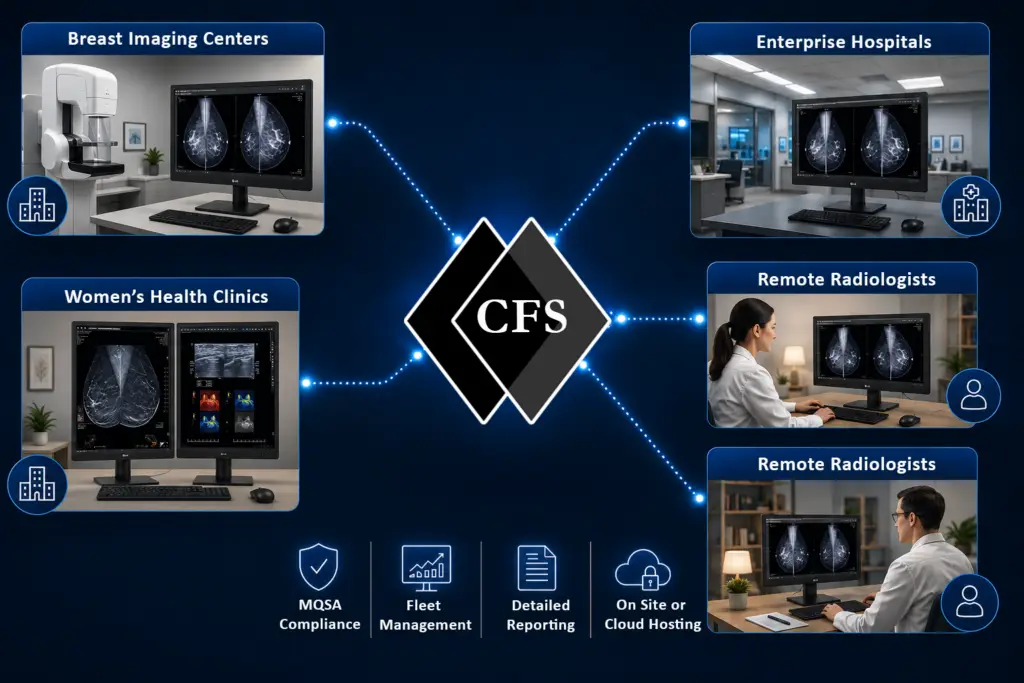
CFS Calibration Suite® Features
Calibration, QA Management & Productivity Tools — In One Platform
CFS™ automates every stage of the display QA lifecycle — from DICOM calibration and conformance testing to enterprise reporting and radiologist workflow tools.
DICOM GSDF Calibration
Calibrate any DBI display to the DICOM Grayscale Standard Display Function from a central location — without a technician at the monitor.
Scheduled QA & Conformance Testing
Automate calibration and conformance tests on a defined schedule. Results are timestamped and logged immediately for compliance documentation.
Automated Email Alerts
Receive email notifications when any display falls outside of defined parameters — catch compliance drift before it becomes a regulatory issue.
Compliance Reports — NY, JCAHO & MQSA
Generate audit-ready reports for New York State, The Joint Commission (JCAHO), and FDA Mammography Quality Standards Act (MQSA) requirements — automatically.
Fleet Management & Asset Tracking
Track every display in your network — calibration history, hours in use, compliance status, and location — from a single enterprise dashboard.
Guided Wizards
Step-by-step wizards for MQSA mammography workflow, DICOM calibration, and New York State testing remove complexity and reduce setup errors.
Historical Data & Audit Logs
Visual test patterns supports MQSA compliance for mammography reading workstations.
AAPM TG18 / TG270 Visual Test Patterns
Automatic delivery of AAPM TG18 visual test patterns supports MQSA compliance for mammography reading workstations — no manual pattern loading required.
Productivity Toolkit
PinPoint, AutoDim, Cursor Genie, Cursor Wrap, and Cursor Locator reduce visual fatigue, improve multi-display navigation, and minimize repetitive strain.
Key Benefits of CFS Calibration Suite®
Continuous DICOM Compliance
CFS Calibration Suite® monitors every DBI display system in your enterprise and remote readers. Keeping your fleet continuously compliant with DICOM Part 14 standards.
Centralized Calibration Management
Developed in the USA, CFS Calibration Suite® provides automated calibration, real-time monitoring, and enterprise-wide management from a single web-accessible console.
Built for Real-World Radiology Workflows
CFS Calibration Suite® is designed around how radiology teams actually work. Scheduling, alerts, and productivity tools integrate without disrupting clinical operations.
Audit-Ready Reporting & Long-Term Value
Complete calibration histories, conformance logs, and compliance records are stored automatically — supporting JCAHO, MQSA, and ACR accreditation with minimal administrative effort.
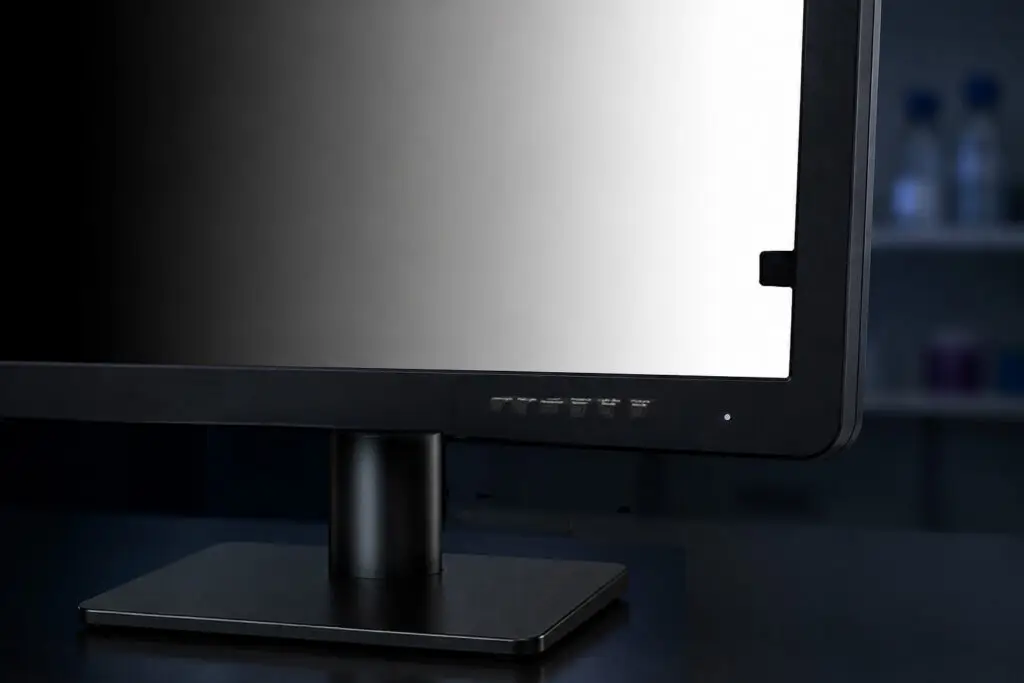
Designed for Every Diagnostic Imaging Environment
Hospitals and Imaging Centers
Manages display compliance across every department — radiology, breast imaging, remote reading, clinical review, and digital pathology — from one console.
Remote Reading
Ensures off-site reading displays match the same DICOM calibration standards as in-hospital primary diagnostic workstations.
Diagnostic Reading Rooms
Optimized for low-light reading environments where consistent luminance and grayscale accuracy are critical to interpretation quality.
Academic & Research Facilities
Provides consistent, standards-verified display performance across teaching, research, and advanced diagnostic environments.
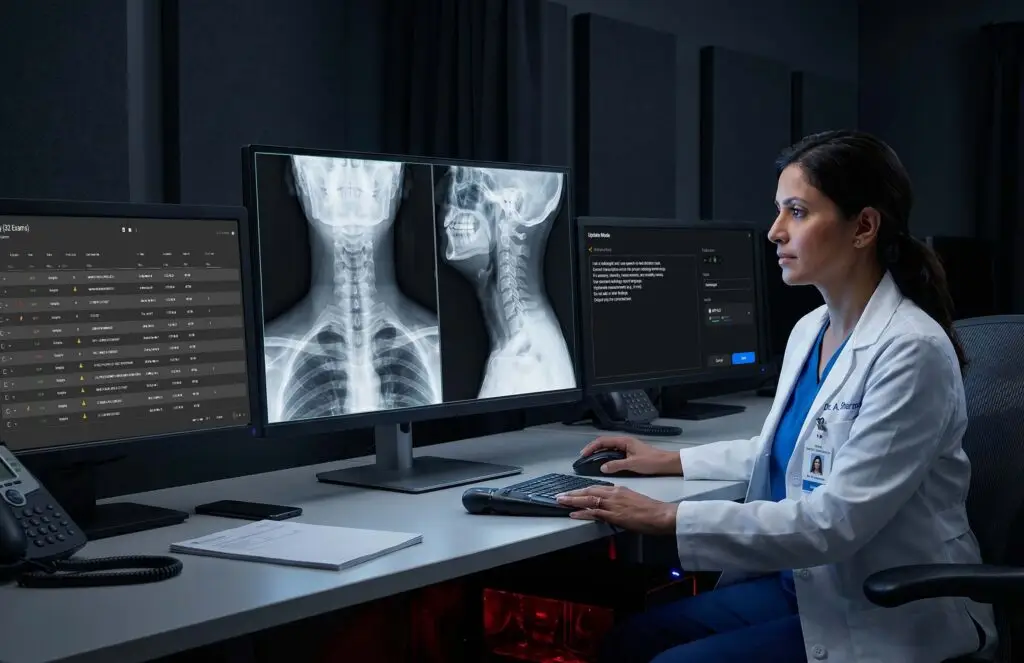
CFS Calibration Suite®: Built for Diagnostic Accuracy at Scale
CFS Calibration Suite® is built for healthcare environments where display compliance is mandatory and manual QA is impractical. It delivers consistent calibration performance across every display in your network — regardless of facility size or reading location.
Supported Imaging Modalities:
- CT (Computed Tomography) — Maintains accurate high-contrast grayscale for anatomical visualization
- MRI (Magnetic Resonance Imaging) — Supports precise gray-scale differentiation for soft tissue interpretation
- Digital X-ray — Consistent brightness and clarity for general diagnostic imaging
- Remote Reading — Remote reading calibration aligned with on-site hospital display standards
- Breast Imaging (5MP and 12MP) — MQSA testing and reporting for FDA-regulated mammography reading workstations
- Digital Pathology — Accurate color and luminance calibration for pathology display workflows
Engineered for Diagnostic Performance
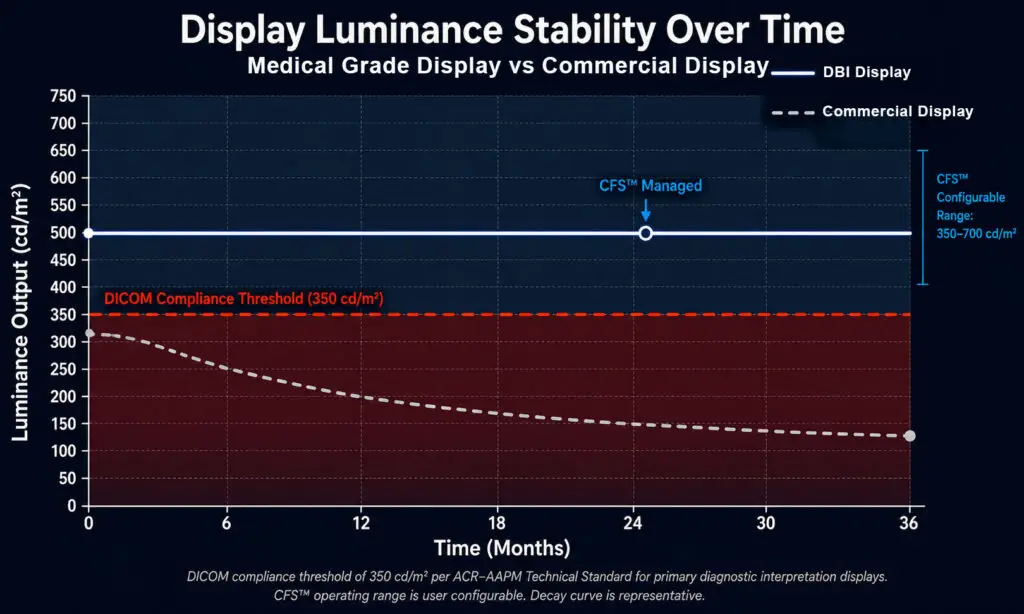
DICOM Part 14 / GSDF Compliance
CFS Calibration Suite® calibrates every display to the DICOM Grayscale Standard Display Function. Radiologists can detect subtle grayscale differences with confidence across all imaging modalities.
Built-In Sensor Architecture
Three integrated sensors — fixed front, ambient light, and backlight — give CFS Calibration Suite® direct, hardware-level measurement accuracy without requiring an external photometer.
Ambient Light Compensation
CFS Calibration Suite® accounts for room illuminance and adjusts display output to maintain DICOM GSDF compliance under various lighting conditions.
Long-Term Calibration Stability
Automated scheduling detects luminance drift before it affects diagnostic accuracy — maintaining consistent performance throughout the display’s clinical lifetime.
Calibration Software FAQs
What is DICOM GSDF calibration and why does it matter?
DICOM Part 14 defines the Grayscale Standard Display Function (GSDF) — the standard that governs how medical displays render shades of gray. A display is only compliant when its luminance response matches this target curve. Without active calibration, displays drift over time, creating diagnostic risk and regulatory exposure. CFS Calibration Suite®automates this calibration continuously across your entire display fleet.
What is the difference between DICOM Part 14 and DICOM GSDF?
DICOM Part 14 is the section of the broader DICOM standard, published by NEMA and the ACR, that defines how grayscale images should be displayed. The Grayscale Standard Display Function (GSDF) is the specific mathematical function defined within Part 14. The GSDF describes the relationship between a digital driving level (the pixel value sent to the display) and the luminance the display should produce at that value, based on the Barten model of human contrast sensitivity. In plain terms: DICOM Part 14 is the standard document; GSDF is the calibration curve it specifies. When a display is described as 'DICOM Part 14 compliant,' it means the display's luminance response has been adjusted to follow the GSDF curve within an acceptable tolerance, typically ±10% for primary diagnostic displays.
What happens if a radiology monitor is not DICOM calibrated?
Yes. Many diagnostic displays are designed for multi-modality use, allowing radiologists to review CT, MRI, ultrasound, PET, and general radiology studies on the same workstation depending on clinical requirements and display specifications. DBI's 5MP and 12MP systems can be used for reading everything, including Breast Imaging.
How do I know if my display is DICOM compliant?
A display is DICOM compliant if it has been calibrated to the GSDF curve within the required tolerance and the conformance has been documented. The practical verification steps are: (1) Locate the factory calibration report for the specific unit — it should show measured Lmax, Lmin, luminance ratio, and the deviation from GSDF at each measured gray level. (2) Run a constancy test using AAPM TG18 or TG270 test patterns (TG18-QC, TG18-LN) and verify that visible low-contrast features are discernible. (3) Use display QA software with a calibrated photometer to measure the current luminance response and compare it to the GSDF target. If the measured curve deviates more than ±10% from the GSDF target at any point, recalibration is required. Displays with integrated front sensors can perform and log this verification automatically.
What is a just noticeable difference (JND) in the context of medical displays?
A Just Noticeable Difference (JND) is the smallest change in luminance that the average human eye can reliably detect under defined viewing conditions. It is the fundamental unit of the DICOM GSDF. Each step in the GSDF's JND index represents one perceptible luminance change, and the GSDF is constructed so that consecutive gray levels on a calibrated display are separated by exactly one JND across the full luminance range from 0.05 to 4,000 cd/m². The DICOM standard defines 1,023 JNDs across that luminance range. A display's practical JND count — determined by its Lmax and Lmin — represents how many clinically distinguishable gray levels it can simultaneously render. A 3MP medical-grade display in a peer-reviewed AJR study rendered 600 JNDs; a consumer LCD rendered 496; a laptop LED rendered 393. The difference represents gray levels that simply cannot be perceived on lower-capability displays, regardless of the information present in the image data.
What is the minimum calibrated brightness for a primary diagnostic radiology monitor?
The minimum luminance (Lmax) for a primary diagnostic display, per ACR–AAPM and AAPM TG18 criteria, is 350 cd/m² for general radiology. For mammography displays, the minimum is higher — 420 cd/m² is required for primary interpretation workstations.
The minimum luminance (Lmin — the display's black level) should be no greater than approximately 1 cd/m² to support a luminance ratio above 250:1, and ideally below 0.5 cd/m² on premium panels. For mammography displays specifically, Lmin must be at least 1.2 cd/m².
All luminance values must be achieved and maintained under actual operating conditions, including with ambient light present. A display that meets its luminance specification at installation but lacks active luminance stabilization may fall below threshold within one to two years as the backlight ages. Ongoing automated QA through CFS Calibration Suite® is essential to verify every display continues to meet its clinical minimum throughout its service life.
Can CFS Calibration Suite® manage calibration across multiple facilities or remote sites?
A non-calibrated display will render grayscale values using its default gamma curve — typically gamma 2.2, which is designed for consumer content, not medical imaging. Gamma 2.2 compresses the shadow and highlight regions of the grayscale range, meaning subtle density differences in dark soft tissue and overexposed bone can become indistinguishable on screen even though the image data contains that information. Clinically, this can lead to missed findings, mischaracterized lesion boundaries, or inconsistent interpretation when the same study is reviewed on different uncalibrated monitors. Regulatorily, using a non-calibrated display for primary diagnostic reads may place the facility outside ACR accreditation requirements and, for mammography, outside MQSA compliance.
How do I manage display calibration compliance for a radiologist working from home?
The most operationally sustainable approach is to standardize on displays with integrated auto-calibration and network-connected QA reporting. These displays automatically perform calibration on a schedule, log luminance status , and transmit compliance records over the facility's encrypted VPN to a central display management server — requiring no action from the radiologist. The facility's biomedical, physics or PACS IT team can review calibration logs and compliance status remotely and generate QA reports for accreditation purposes.
Standardizing on a single display model for all home stations simplifies this process further by reducing the number of QA software configurations to maintain. For facilities using displays that require manual calibration initiation, documented policies and automated reminder systems are essential — the 2025 Springer journal study found compliance degraded significantly when manual initiation was required without active follow-up.
Does a home reading display need an integrated calibration sensor?
For practical compliance management at scale, yes. A display without an integrated photometric sensor requires the radiologist or a technologist to physically connect an external USB photometer, manually initiate calibration software, and log the result — a process that is consistently under-executed in home environments where competing clinical priorities deprioritize display QA. The 2025 Springer journal study of 52 remote workstation deployments found that stations relying on manual calibration initiation required substantially more compliance remediation and follow-up than those with built-in auto-calibration. For a facility managing dozens or hundreds of home reading stations, the administrative and compliance overhead of manual calibration at each station is operationally unsustainable. An integrated sensor that automatically calibrates on a schedule and reports compliance status to a central server is the only practical solution for large-scale home reading programs.
How can Double Black Imaging help evaluate and manage display calibration across our facility?
Double Black Imaging offers more than software. For facilities evaluating their display fleet or building a new calibration management program, DBI provides on-site assessments, site surveys, and hands-on QA/QC services performed by experienced imaging specialists.
A fleet evaluation typically identifies displays that are out of DICOM compliance, approaching end of useful luminance life, or missing from any structured QA program. DBI can assess your current environment, recommend a CFS Calibration Suite® deployment plan, and provide installation and training to get your team fully operational.
For facilities managing remote reading locations or teleradiology workstations, DBI can extend that assessment across off-site environments — ensuring every display in your network meets the same compliance standards as your primary reading rooms.To schedule a site survey or fleet evaluation, contact DBI directly at (303) 404-2222 or sales@doubleblackimaging.com.
Why calibrate pathology displays to sRGB instead of DICOM GSDF?
The DICOM Grayscale Standard Display Function (PS3.14) was designed for grayscale radiology images. No equivalent color display function has been formally adopted, so sRGB serves as the practical reference for color pathology. FDA-cleared digital pathology displays reflect this. The 510(k) filings for Digital Pathology Displays all list sRGB with a D65 white point.
Read more about the importance of sRGB calibration for Digital Pathology here!
Is “gamma 2.2” the same as sRGB?
Not exactly. The sRGB tone curve has a short linear segment near black, followed by a 2.4 exponent. Together they approximate gamma 2.2, but they diverge in the shadows. Calibrating to a pure 2.2 power curve is a different target from sRGB.
Testimonials
Automate Your Display QA Program
Speak with a DBI calibration specialist to assess your facility’s display compliance needs and build a CFS™ deployment plan.