
Designing a Diagnostic Breast Imaging Remote Reading Environment
Lighting standards, display calibration, and ergonomic workstation guidance for breast imaging radiologists reading from home.
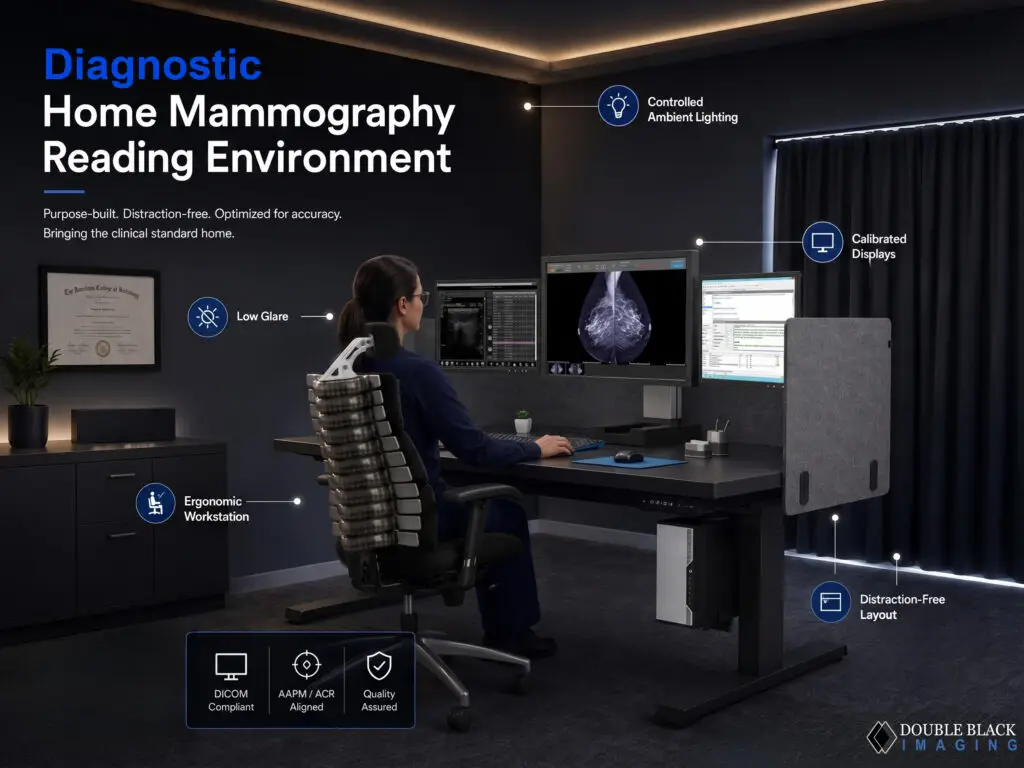
Introduction
As remote diagnostic work becomes increasingly common, radiologists performing mammography reads from home must replicate the image quality and environmental control of diagnostic workstations. One of the most critical — yet often overlooked — aspects is the ambient lighting environment. Proper room darkness and careful workstation placement are essential for maintaining diagnostic accuracy and reducing eye fatigue.
1. The Importance of Controlled Ambient Lighting
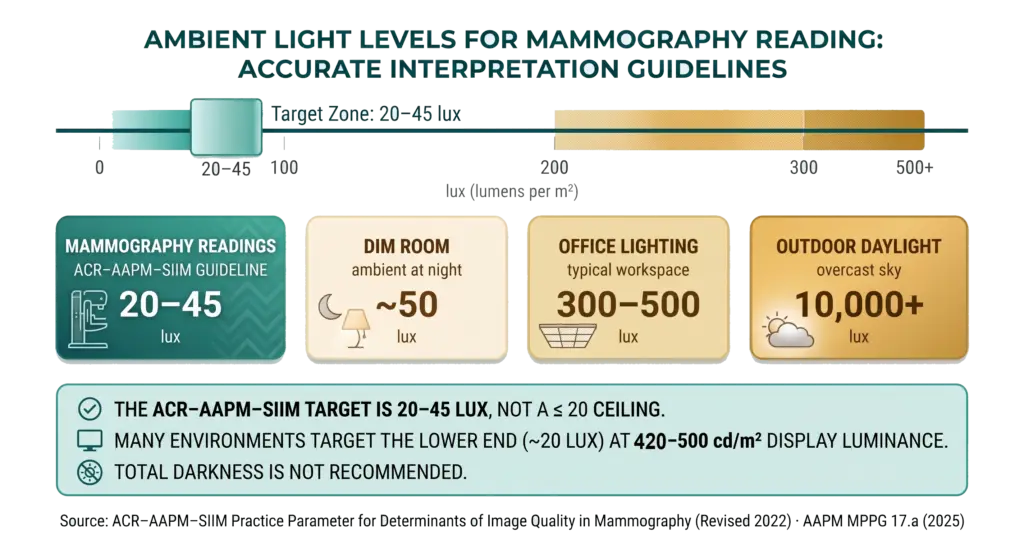
Mammography requires interpretation of subtle grayscale differences that can be easily distorted by ambient light. Even low levels of stray light can alter perceived contrast and obscure microcalcifications or faint lesions. Consistent with ACR–AAPM–SIIM guidance, ambient illumination in a mammography reading environment should generally be maintained in the 20–45 lux range, close to twilight/dim-controlled room lighting, while avoiding total darkness.
Per ACR–AAPM–SIIM guidance, ambient illuminance in a mammography reading environment should be approximately equal to the average luminance of the displayed image — generally in the 20–45 lux range — and total darkness is not recommended. Many mammographyspecific environments target the lower end of this range where display luminance is set at ≥420 cd/m² minimum required for breast imaging, with >450 cd/m² recommended for optimized contrast. The newest guidance, AAPM MPPG 17.a (2025), specifically addresses remote and home workstation environments and requires that ambient luminance or illuminance be measured as part of any quality management program — making ambient light control not just a best practice but a formally documented element of any recommended QM program — one that regulators and accreditation bodies are explicitly encouraged to adopt.
Maintaining proper ambient light levels ensures:
• Calibrated display luminance functions at its full diagnostic range.
• Diffuse reflections and veiling glare are minimized across diagnostic display surfaces.
• Visual adaptation remains stable between cases throughout extended reading sessions.
• Low-contrast image details critical to cancer detection are not masked by screen reflections.
2. Room Design and Layout
A home reading station should be set up in a dedicated, enclosed space where lighting can be tightly controlled. The ACR–AAPM–SIIM Practice Guideline emphasizes that ambient light should be low and consistent — and that stray light from bright sources (windows, overhead fixtures, adjacent screens) is particularly detrimental in a hybrid viewing environment.
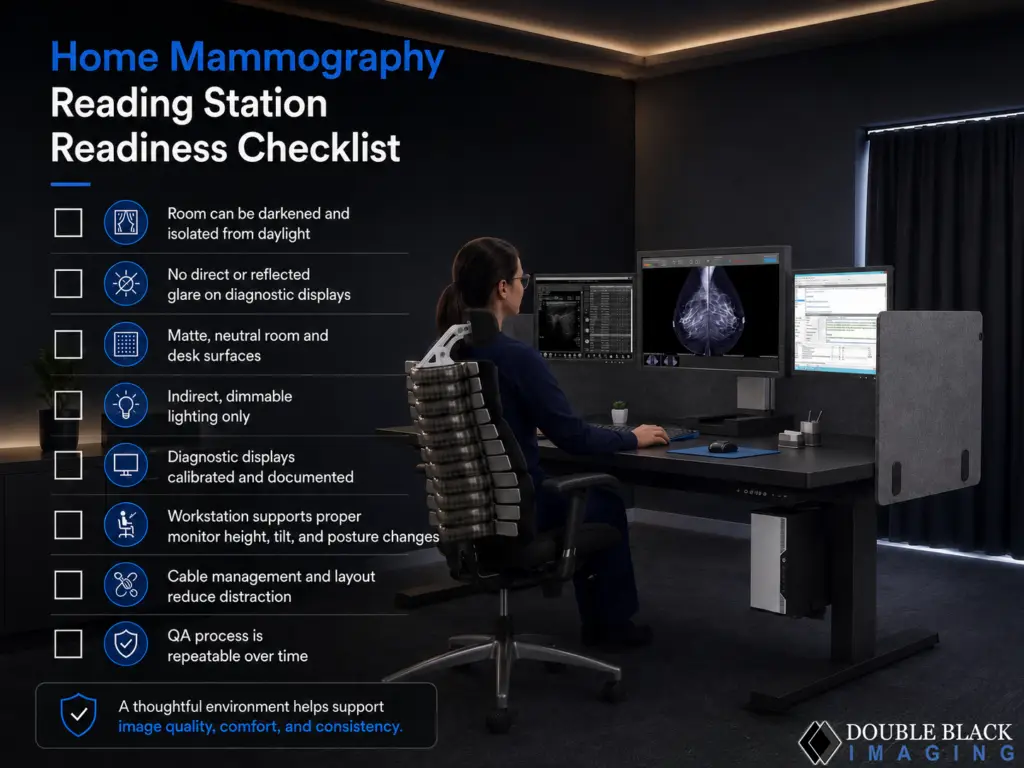
Essential room design requirements:
• Blackout coverage — use curtains, blinds, or window film to eliminate all-natural light variation across the reading day.
• Matte, neutral-gray wall and surface finishes to prevent secondary reflections from any residual light sources.
• Dimmable indirect LED lighting (4000K color temperature recommended) for controlled background illumination that does not contribute to screen glare.
• No overhead or task lighting directed toward display surfaces.
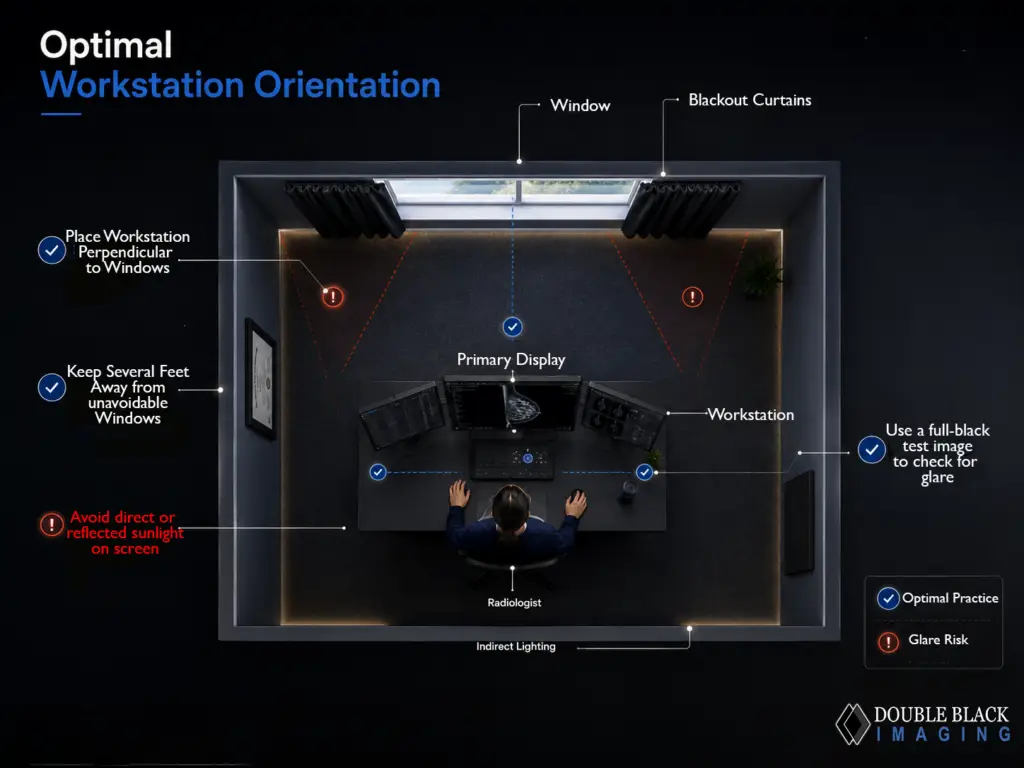
Figure 2 — Optimal workstation orientation: perpendicular to windows with blackout coverage, indirect perimeter LED lighting, and glare-free display positioning.
3. Workstation Placement and Light Source Management
If a window cannot be eliminated, position the workstation perpendicular to it and at least several feet away. Direct or reflected sunlight on a monitor surface—even through blinds—can drastically reduce contrast sensitivity. Reflections from nearby light sources should also be checked by displaying a full-black test image on the monitor; any visible glare or highlights indicate the need for repositioning or additional shielding.
Best practices for workstation placement:
• Position displays perpendicular to any windows — never facing toward or away from them directly.
• Maintain maximum practical distance from unavoidable light sources.
• Use a full-black test image on diagnostic displays to identify any residual reflections or veiling glare before beginning a reading session.
• Apply light-blocking panels or acoustic baffles on the open sides of the workstation if the room cannot be fully enclosed.
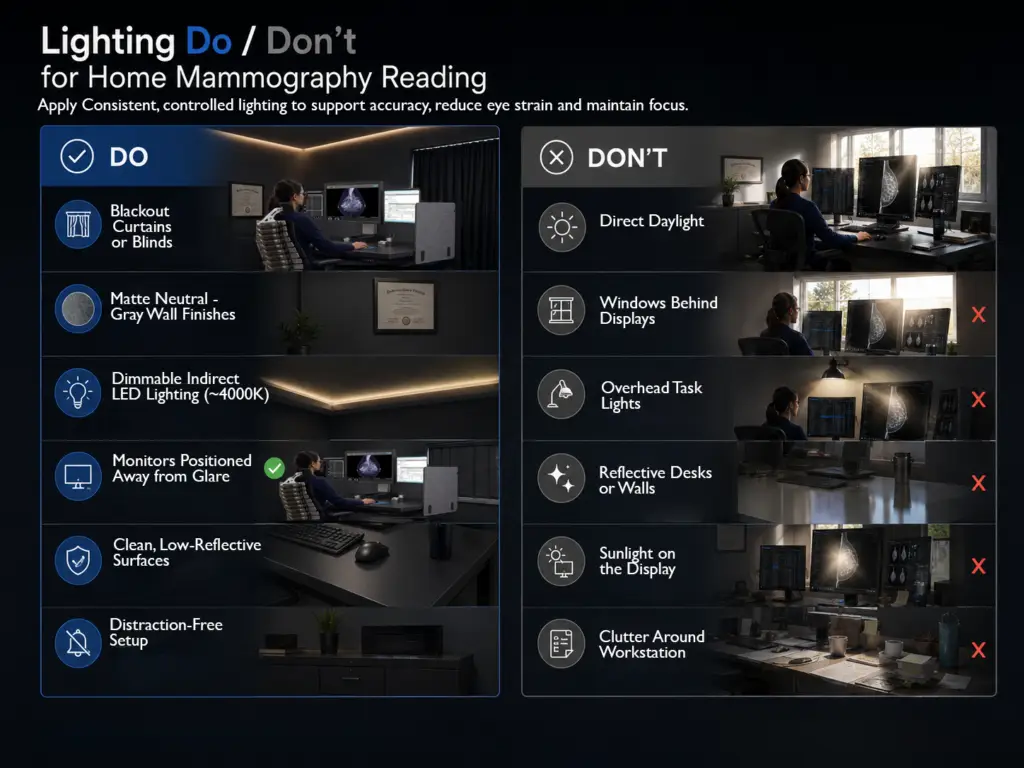
Figure 3 — Lighting Do / Don’t: the most common home reading environment mistakes and how to correct them.
4. Display Calibration and Environmental QA
Even a perfectly darkened room provides no diagnostic protection if the displays are not calibrated. Display calibration to DICOM Part 14 (Grayscale Standard Display Function) is a prerequisite for mammography reading from any environment.
Key calibration and environmental QA requirements:
• MQSA requires displays to follow the manufacturer’s QC protocol — making vendor-supplied calibration software a compliance tool.
• CFS auto-calibration maintains DICOM Part 14 conformance and generates proactive alerts when display performance drifts outside tolerance.
• Ambient light measurement should be formally documented as part of any compliant QM program.
• Complete QC records must be retained and available for MQSA inspectors and accreditation bodies.
5. Ergonomics: The Overlooked Compliance Factor
Ambient light and display calibration receive the most regulatory attention — but ergonomics are equally important for sustained diagnostic accuracy. Radiology sessions demand a workstation that actively supports posture, reduces musculoskeletal strain, and allows the radiologist to maintain consistent viewing distance and angle across every case.
Factors including ambient light, temperature, noise, posture fatigue, and poor ergonomics may have significant effects not only on radiologist comfort but also on the quality, accuracy, and consistency of image interpretation. — ACR–AAPM–SIIM Practice Parameter for Determinants of Image Quality in Mammography (Revised 2022)
Double Black Imaging ergonomic workstations are purpose-built for breast imaging radiologists:
• Programmable sit-stand height presets — change posture without interrupting workflow.
• Independent monitor height, tilt, and swivel adjustment — optimal screen position for each reading session and each radiologist.
• Integrated cable management — clean, distraction-free reading environment.
• Low-glare display coatings matched to controlled low-light environments.
• Compact, configurable footprint that fits dedicated home reading spaces.
Conclusion
A compliant home mammography reading environment is not simply about having a good monitor in a dark room. It requires a calibrated, documented system: controlled ambient illuminance in the 20–45 lux range (targeting the lower end for mammography-grade display luminance), isolation from uncontrolled light sources, DICOM-calibrated diagnostic displays with regular QA, and an ergonomic workstation that sustains radiologist performance across extended sessions.
Double Black Imaging designs every component of this system to work together — bringing enterprise diagnostic confidence to wherever radiologists work.
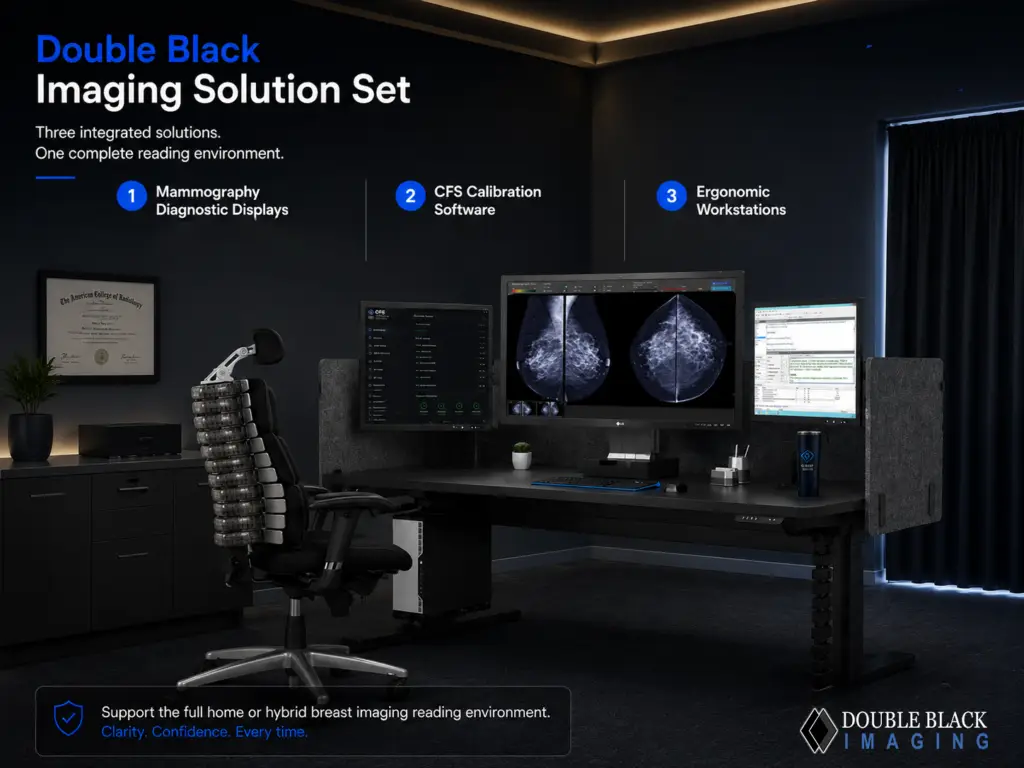
Figure 4 — The complete DBI solution set: diagnostic displays, CFS calibration software, and ergonomic workstations for home or hybrid breast imaging.
References
- American College of Radiology (ACR), American Association of Physicists in Medicine (AAPM), and Society for Imaging Informatics in Medicine (SIIM). ACR–AAPM–SIIM Practice Parameter for Determinants of Image Quality in Mammography. Revised 2022 (Resolution 46); amended 2023 (Resolution 2c).
Official ACR Practice Parameter - Kanal KM, Krupinski E, Berns EA, et al. ACR–AAPM–SIIM Practice Guideline for Determinants of Image Quality in Digital Mammography. Journal of Digital Imaging. 2013;26(1):10–25. doi:10.1007/s10278-012-9521-3.
View Published Article - American College of Radiology (ACR), American Association of Physicists in Medicine (AAPM), and Society for Imaging Informatics in Medicine (SIIM). ACR–AAPM–SIIM Technical Standard for Electronic Practice of Medical Imaging. Revised 2022 (Resolution 48).
Official ACR Technical Standard - American College of Radiology (ACR). ACR Practice Parameter for the Performance of Screening and Diagnostic Mammography. Revised 2023 (Resolution 10).
Official ACR Practice Parameter - U.S. Food and Drug Administration (FDA). Mammography Quality Standards Act and Regulation Amendments: Small Entity Compliance Guide. Guidance for Industry and Food and Drug Administration Staff. August 26, 2024. See also 21 CFR § 900.12, Quality Standards.
FDA Guidance Document
21 CFR § 900.12 – Quality Standards - Bevins NB, Flynn MJ, Silosky MS, et al. Display Quality Assurance: The Report of AAPM Task Group 270. AAPM Report No. 270. American Association of Physicists in Medicine; January 2019. doi:10.37206/183.
Official AAPM Report 270 - Milman R, Bevins NB, Alhamami M, et al. AAPM Medical Physics Practice Guideline MPPG 17.a: Quality Management for Mammography Review Workstation Displays. Journal of Applied Clinical Medical Physics. 2025;26(4):e14625. doi:10.1002/acm2.14625.
View Full Published Article - DICOM Standards Committee. DICOM PS3.14: Grayscale Standard Display Function. National Electrical Manufacturers Association (NEMA). Edition 2026d. Accessed October 2026.
Official DICOM PS3.14 Standard - Pollard BJ, Samei E, Chawla AS, Baker J, Ghate S, Kim C, Soo MS, Hashimoto N. The Influence of Increased Ambient Lighting on Mass Detection in Mammograms. Academic Radiology. 2009;16(3):299–304. doi:10.1016/j.acra.2008.08.017.
View Published Article – PubMed