
Do you know your Lifetime Breast Cancer Risk?
Understanding your risk can help guide the conversation about appropriate screening and may help develop next steps in your care.
Breast Cancer Awareness Month brings an important reminder to schedule recommended breast cancer screening. But there is another question worth asking:
Do you know your lifetime risk of developing breast cancer?
Many people understand the importance of mammography but may not realize that screening recommendations are not necessarily the same for everyone. Personal medical history, family history and other risk factors can influence an individual’s risk — and, in some cases, may affect recommendations for additional screening.
What is a Breast Cancer Risk Assessment?
Breast cancer risk-assessment tools help healthcare providers estimate an individual’s likelihood of developing breast cancer over a specified period of time.
One commonly used tool is the Tyrer-Cuzick model, also known as the IBIS Breast Cancer Risk Evaluation Tool.
The model incorporates multiple factors rather than looking at family history alone. The current model includes factors such as family history, age and other established breast cancer risk factors, and its later versions incorporate mammographic breast density.
The result may include both a shorter-term risk estimate and an estimated lifetime risk.
A risk score is not a diagnosis or prediction that someone will develop breast cancer. Instead, it gives patients and healthcare providers additional information that can help guide discussions about screening and risk management.
Why does Lifetime Risk Matter?
Most women are considered at average risk and follow standard breast cancer screening recommendations.
However, some women are considered at higher risk.
The American Cancer Society recommends that women at high risk based on certain factors receive a breast MRI and mammogram every year, typically beginning around age 30. One group included in this recommendation is women with an estimated lifetime breast cancer risk of approximately 20% to 25% or greater, based on risk-assessment tools that rely largely on family history, including relatives on both sides of the family.
For women whose estimated lifetime risk is below 15%, the American Cancer Society recommends against MRI screening. For those in the 15% to 20% range, it notes there is not yet enough evidence to recommend for or against yearly MRI — another reason to talk through your result with your healthcare provider.
MRI does not replace mammography. For women for whom MRI screening is recommended, it is generally used in addition to mammography, because the two methods can detect different findings.
This is one reason understanding personal risk can be so important.
A woman may faithfully undergo mammography every year and still benefit from asking whether her personal risk factors place her in a different screening category.
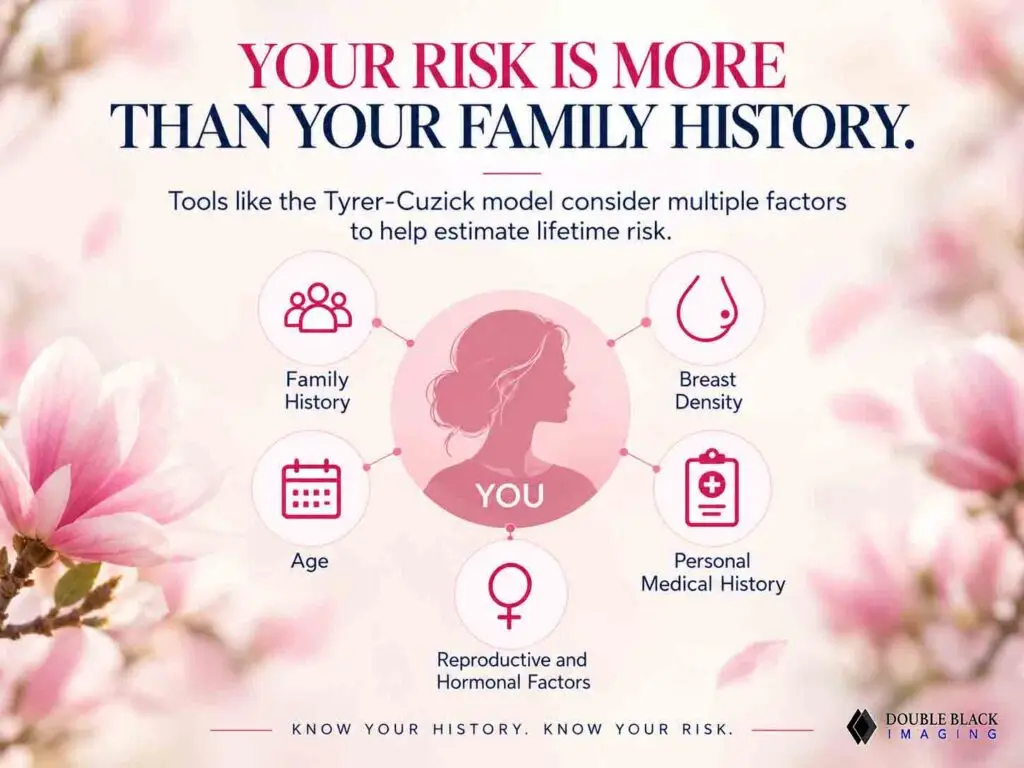
Family History Is Important — But It Isn't the Whole Story?
One common misconception is that breast cancer risk is primarily determined by whether your mother or sister had breast cancer.
Family history is certainly important, but risk assessment can take a broader view.
Depending on the model being used, factors considered may include:
- Age
- Family history of breast and ovarian cancer
- Personal medical and breast history
- Reproductive and hormonal factors
- Certain genetic factors
- Mammographic breast density
That means someone without an obvious first-degree family history can still have factors that influence her overall risk.
Likewise, risk isn’t static. The American Cancer Society recommends reviewing changes in personal and family history over time because a new cancer diagnosis within a family, for example, can affect how risk is assessed.
Breast Cancer Awareness Includes Men, Too
Although breast cancer occurs overwhelmingly in women, men can develop breast cancer as well.
Fewer than 1% of breast cancers in the United States occur in men, but the American Cancer Society estimates that approximately 2,670 U.S. men will be diagnosed with invasive breast cancer in 2026.
Routine mammography screening is not recommended for most men because male breast cancer is uncommon. Instead, awareness of changes is particularly important.
The most common symptom of breast cancer in men is a breast lump, often located under or near the nipple. Other potential signs include nipple changes, skin dimpling or puckering, redness or scaling, unexplained nipple discharge, or a lump or swelling under the arm or near the collarbone — which can sometimes appear before a lump in the breast can be felt. Any new breast change should be evaluated by a healthcare professional.

One More Question This October
Breast cancer awareness is about more than wearing pink.
It’s about understanding your body, knowing your family history, following recommended screening — and understanding whether your own risk may warrant a different conversation.
You don’t need to calculate your own risk or interpret a score by yourself. Instead, this October, consider asking your healthcare provider:
“Have I had a formal breast cancer risk assessment?”
or simply:
“What is my lifetime breast cancer risk?”
Your physician, breast imaging center or other healthcare provider can help determine whether a formal risk assessment is appropriate and what the results mean for you.
The American Cancer Society specifically encourages people to discuss with their healthcare provider whether using a breast cancer risk-assessment tool may be helpful. The American College of Radiology goes a step further, recommending that all women — particularly Black women and women of Ashkenazi Jewish descent — have a risk assessment by age 25 to help determine whether screening should begin earlier than age 40.
That simple question may lead to a more informed conversation about the screening plan that’s right for you.
At Double Black Imaging, we are proud to support the breast imaging professionals and healthcare organizations working every day to advance breast cancer detection and patient care.
This October, Start the conversation.
This article is provided for general educational purposes and is not intended to replace medical advice. Individual screening recommendations should be discussed with a qualified healthcare provider.