
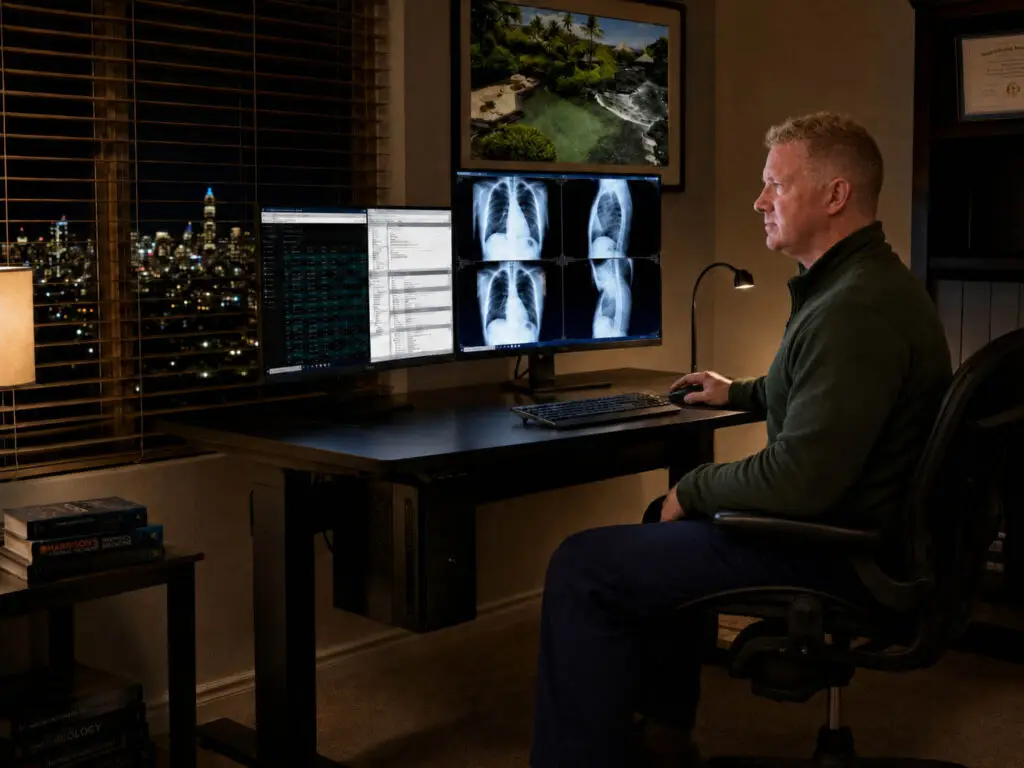
RADPAC launched a Teleradiology Subcommittee this summer. If you manage remote reading, this one is worth paying attention to.
Kimberly Beavers, MD, a remote breast radiologist at NYU Langone Health, chairs the new group. She has been asking teleradiologists directly what the subcommittee should take on: licensure across state lines, reimbursement parity, CMS supervision flexibility, AI integration and liability. Radiology Business covered the launch on July 7.
The individual policies matter less here than what the launch signals. Remote reading has stopped being a workaround. With the radiologist shortage where it is, it is often the only way to staff nights, weekends, and subspecialty coverage. It has also become a recruiting tool, since the best candidates increasingly will not move for a job. Patients see the difference in turnaround time.
There is a piece of this that rarely comes up in the policy conversation. Licensure compacts and telehealth extensions can make a remote read legal and billable. Neither one says anything about the screen the radiologist is actually looking at.
Mammography is the exception, and it is instructive. The FDA regulates mammography displays under MQSA, and since September 2024 those displays have to carry the appropriate premarket authorization and run a documented quality management program.
The standard of care does not change with the location
A remote read carries the same diagnostic weight as one done in a hospital reading room. Same expectations, same liability, same patient.
Simple enough as an ethical matter, messier as a technical one. If teleradiology is going to be treated as equivalent to on-site interpretation, the display environment has to be equivalent too, and plenty of home setups are not close.
These gaps are common for remote reading stations:
- Consumer monitors with no DICOM 3.14 calibration
- Luminance drift nobody catches, because nothing is measuring it
- Ambient lighting somewhere between “living room” and “sunroom”
- No way for the PACS team to confirm compliance without calling each radiologist
- Nothing to hand an auditor who asks for QA records
Every one of those is fixable without waiting on legislation.
What a compliant remote setup actually needs
Displays calibrated against a real standard
Two documents set the bar. The ACR–AAPM–SIIM Technical Standard for Electronic Practice of Medical Imaging, revised in 2022, applies wherever interpretation happens, including a spare room three states away. The ACR–AAPM Technical Standard for Diagnostic Interpretation Displays goes further, covering minimum luminance, luminance ratio, uniformity, and the QC testing that confirms all of it.
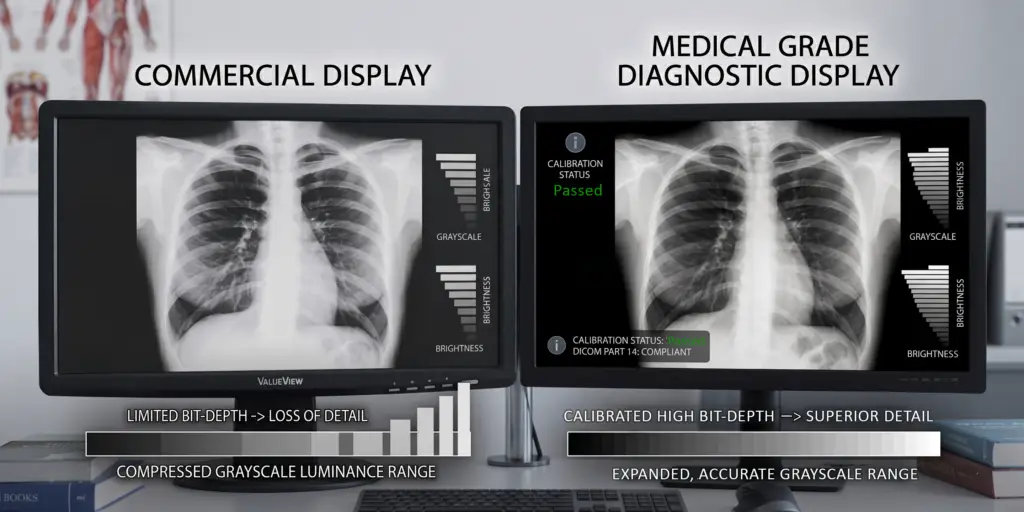
Both come back to DICOM 3.14 grayscale calibration and performance you can measure. A consumer monitor does not meet that out of the box and drifts quickly.
Calibration that runs without intervention
In a hospital, techs, physicists, and radiologists see a display every day. A physicist or biomed team runs QC on a schedule. At home, who is doing the checking?
This is why front-sensor auto-calibration matters so much for remote reading. The display measures its own luminance and grayscale output and corrects for drift without anyone touching it. Every measurement lands in a report, which turns a maintenance function into an audit trail.
Visibility across the whole fleet
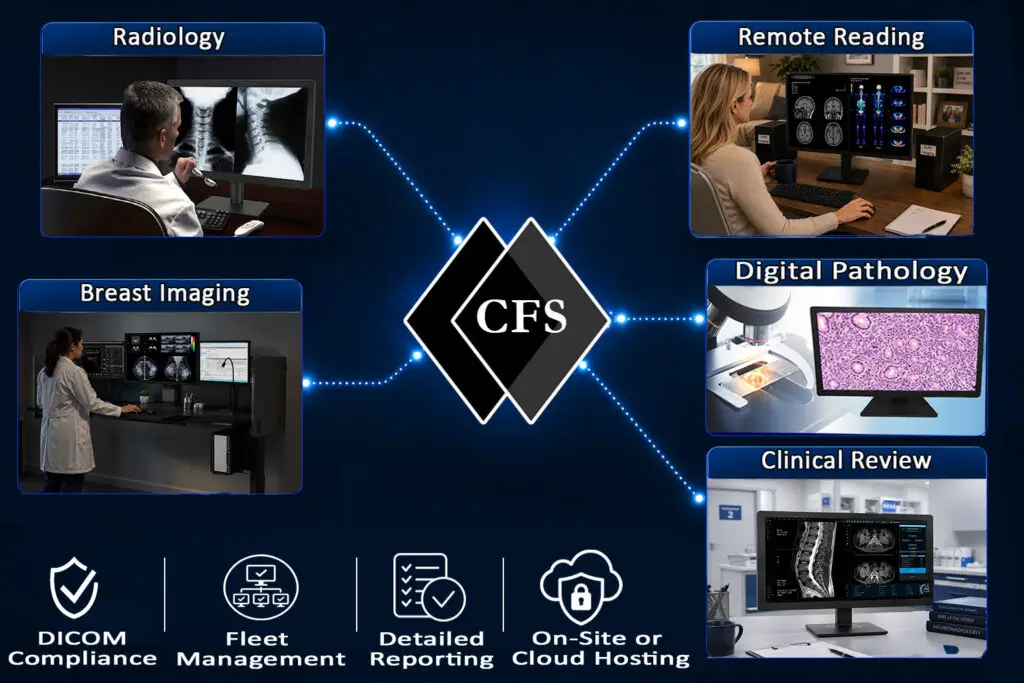
.Most remote programs skip this step, partly because fleet monitoring is often sold as a paid add-on, which makes it look optional. CFS WebManager is included with every DBI display. A display nobody can monitor is not really being managed.
Consider a group running 40 home reading stations across three states. Without centralized monitoring, verifying calibration compliance means 40 phone calls or emails. With CFS, it is a single login to the WebManager dashboard. CFS Calibration Suite ships with WebManager for enterprise-wide monitoring, email alerts when a display falls out of spec, and reporting you can put in front of an auditor.
Credentialing conflicts between CMS and ACR standards were on Beavers’ list of what makes the current landscape complicated. Remote reading answers to a lot of standards at once, and equipment QA is one that often gets missed.
Lighting you can control
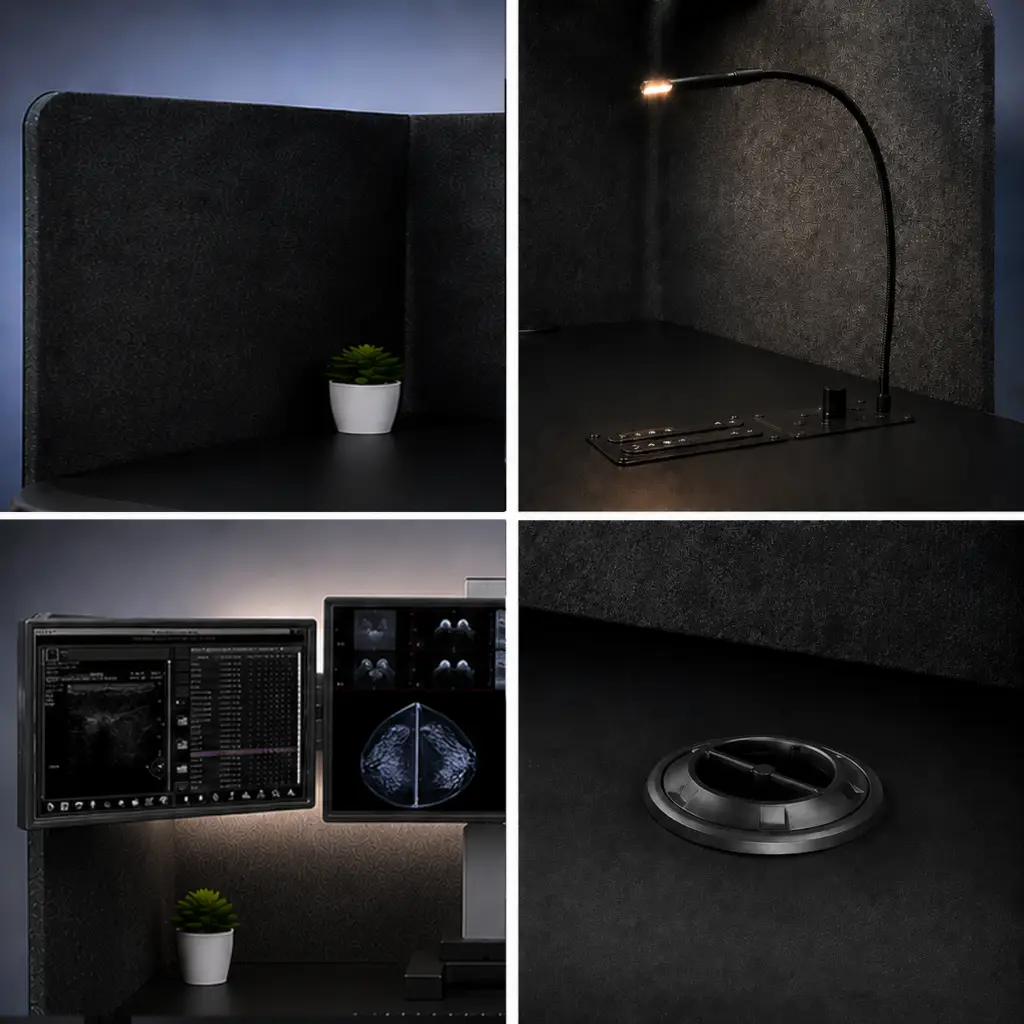
Every hospital reading room is built around controlling light. Remote reading stations should be an extension of the onsite reading room. Ambient light washes out low-contrast detail and tires your eyes faster. The ACR–AAPM–SIIM standard recommends keeping reading-area illuminance well below ordinary room lighting.
Almost no home office meets that on its own. Two things close the gap: integrated task and backlighting, which controls what is around the display, and digital ambient light compensation.
Five questions worth asking about remote reading
Whether you are running a national teleradiology group or credentialing two remote radiologists:
- Can you prove every remote display is DICOM 3.14 calibrated, or is it an assumption?
- When a home display drifts out of spec, who finds out, and how long does that take?
- Would your QA documentation hold up in an accreditation review?
- Are remote mammography readers on displays cleared for breast imaging?
- Does your remote hardware standard match what you would install in the hospital?
If a couple of those landed uncomfortably, you are in the same spot as most groups that scaled remote reading fast.
Where this is heading
RADPAC forming a teleradiology subcommittee tells you something about where the specialty is headed. The rules governing remote reading are being written right now. The groups that come through it in good shape will be the ones whose home setups already look like their hospital setups.
Turning remote reading sites into an extension of the reading room pays off immediately — in image quality, in radiologist experience, and in what you can document.
About Double Black Imaging: DBI designs, integrates, and services diagnostic display solutions at our Colorado facility. Every display ships with CFS Calibration Suite for automated DICOM 3.14 compliance and enterprise QA management, backed by a 5-year warranty and USA-based support.
Standardizing your remote reading environments? Request A Quote and talk it through with our imaging specialists.
Sources & Further Reading
- Stempniak, M. “RADPAC launches new subcommittee dedicated to teleradiology advocacy.” Radiology Business, July 7, 2026. https://radiologybusiness.com/topics/healthcare-management/healthcare-policy/radpac-launches-new-subcommittee-dedicated-teleradiology-advocacy
- ACR–AAPM–SIIM Technical Standard for Electronic Practice of Medical Imaging (Revised 2022). Society for Imaging Informatics in Medicine. https://siim.org/resource/acr-aapm-siim-technical-standard-for-electronic-practice-of-medical-imaging-2022/
- ACR–AAPM Technical Standard for Diagnostic Interpretation Displays. ACR Practice Parameters and Technical Standards library. https://www.acr.org/Clinical-Resources/Clinical-Tools-and-Reference/Practice-Parameters-and-Technical-Standards
- AAPM Report 270: Display Quality Assurance. American Association of Physicists in Medicine.
- ACR White Paper on Teleradiology Practice: A Report From the Task Force on Teleradiology Practice. Journal of the American College of Radiology, 2013. https://www.jacr.org/article/s1546-1440(13)00185-3/fulltext
- NEMA PS3.14: DICOM Grayscale Standard Display Function. National Electrical Manufacturers Association.